DuffAM prints FDM. That's the honest starting point for this whole guide — and it means what follows isn't a sales pitch for FDM over everything else. It's the same thing you'll hear before you order: sometimes FDM is exactly right, and sometimes it isn't, and you deserve to know which before you commit to either.
Three processes actually matter for most people comparing options: FDM (filament, what DuffAM prints), SLA/resin (UV-cured liquid), and SLS (laser-sintered powder). Here's what each one is genuinely good at.
Quick ReferenceAt a Glance
| Process | Best For | Watch Out For |
|---|---|---|
| FDM | Functional parts, larger sizes, real-world durability, lower cost | Visible layer lines, lower out-of-box precision than resin |
| SLA / Resin | Fine detail, miniatures, jewelry, smooth out-of-the-box finish | Brittle over time, most formulations degrade fast in direct sun |
| SLS | Complex geometry with no supports needed, engineering nylon parts | Industrial equipment — not something a desktop shop offers |
Tolerance, Finish, and Cost — Not Marketing Language
| Process | Typical Tolerance | Surface Finish (out of box) | Material Cost |
|---|---|---|---|
| FDM | ±0.2–0.5mm (desktop) | Visible layer lines, moderate roughness | $15–25 / kg filament |
| SLA / Resin | ±0.05–0.1mm | Smooth, high detail — the best of the three out of the box | $25–50 / liter resin |
| SLS | ±0.25–0.3mm | Grainy/granular unless vapor smoothed or media blasted | $30–80+ / kg powder |
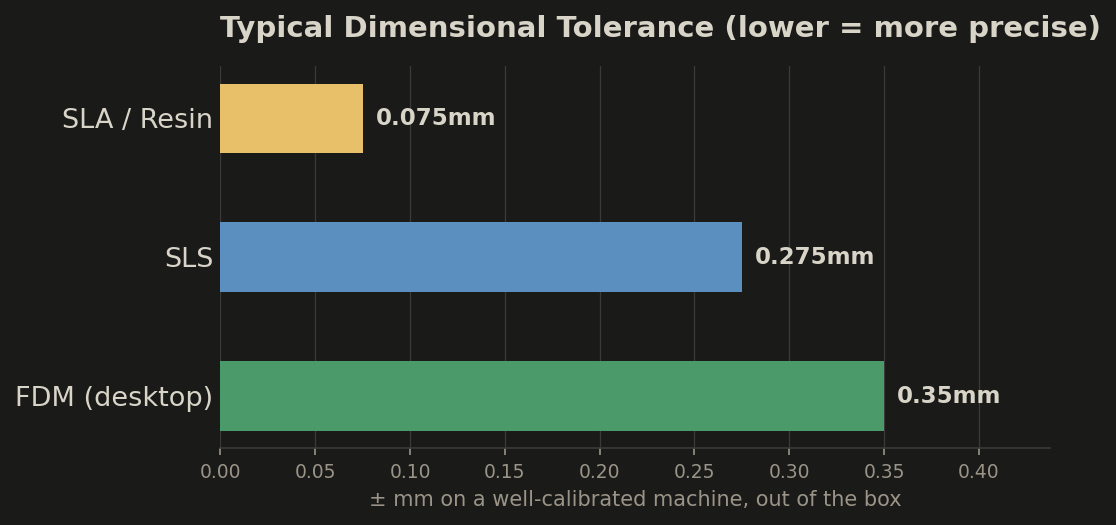
One thing worth calling out on tolerance: the FDM range above is the general desktop-printer default, not DuffAM's actual number. DuffAM's committed tolerance — under 0.2mm on parts under 100mm — sits at the tight end of that FDM range because it comes from tuning per material and per part, not printing on default settings. It still won't out-precision SLA on fine detail, and that's the honest limit, not a sales pitch.
FDMWhat FDM Is Actually Good At
FDM builds parts by extruding melted filament layer by layer — it's the most accessible process, the least expensive per part, and the one that scales best to larger sizes without a proportional cost jump. It's also the most forgiving process to iterate on: reprints are cheap, materials are easy to source, and functional/engineering-grade options (PCTG, ASA-CF, Nylon, PPS-CF) give it real mechanical range beyond just prototypes.
Where it loses: fine detail. Layer lines are visible without post-processing, and out-of-the-box tolerance trails SLA. If a part's job is to look flawless up close — a miniature, a jewelry piece, a detail-critical prototype — FDM is not the honest recommendation, regardless of what any FDM-only shop tells you.
SLA / ResinWhat Resin Is Actually Good At
SLA cures liquid photopolymer with UV light, building in much finer layers than FDM can manage — the result is smooth surfaces and sharp detail straight off the printer, no post-processing required to look good. That makes it the right call for miniatures, figurines, jewelry patterns, and anything where surface quality matters more than mechanical toughness.
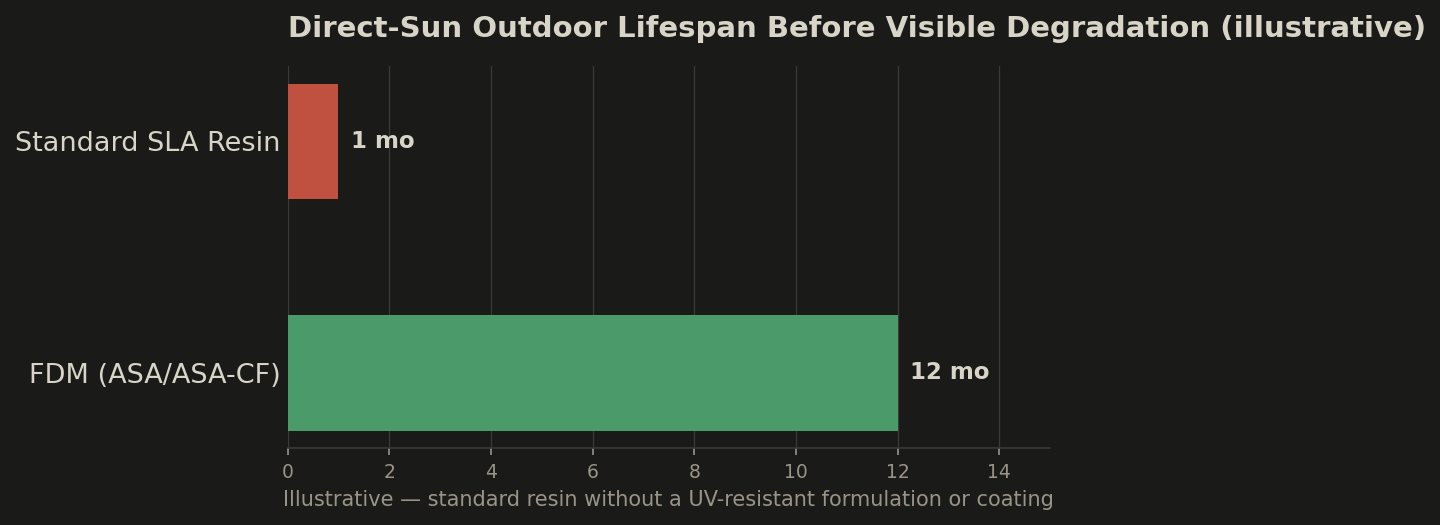
Standard SLA resin has a real weakness that doesn't show up in a same-day comparison: UV exposure. Uncoated, standard-formulation resin left in direct sunlight can start showing cracking and chalking in as little as 2–4 weeks, and even indoors under normal light, parts noticeably stiffen and grow more brittle within about 6 months as the resin continues curing and oxidizing. UV-resistant resin formulations and protective coatings exist and meaningfully extend that lifespan — but the standard resin most shops print with isn't built for a part that lives outside or gets handled for years. If a resin part needs to last, ask what resin it's actually printed in, not just "is it resin."
The same honesty applies inside FDM, too — not every DuffAM material is equally sun-proof either. See PCTG-CF Outside: What It Handles, and Where ASA Takes Over for exactly where that line sits.
What SLS Is Actually Good At
SLS fuses powdered nylon with a laser, one layer at a time, with the surrounding unfused powder acting as its own support — meaning genuinely complex geometry, internal channels, and interlocking assemblies are possible without support scars or the design compromises FDM and SLA both require. Parts come out with real mechanical properties (it prints actual engineering nylon, not a resin approximation of it) and decent out-of-box tolerance.
The honest limit here is access, not quality: SLS requires industrial powder-bed equipment that isn't in most workshops, desktop shops, or garages — DuffAM included. It's genuinely the right process for the right part, but it's also the one most likely to mean going to a larger service bureau rather than a solo maker, and material costs run meaningfully higher than either FDM or SLA.
Decision FrameworkThree Questions That Actually Decide It
- Does the part need to survive real mechanical use — impact, load, flex, outdoor exposure? FDM (with the right material) or SLS. Not standard resin.
- Does the part's job depend on fine surface detail — a face, jewelry, engraved text under 1mm? SLA is the honest answer, even if that means DuffAM isn't the right shop for it.
- Does the geometry need internal channels or complex interlocking features with no way to add supports? SLS, and expect to go to a larger service bureau for it.
If none of those apply — most functional, everyday, and mid-detail parts — FDM is a genuinely good answer, not just the process DuffAM happens to print.
TakeawayWhy This Page Exists
A shop that only tells you why its own process is right isn't giving you a real answer. If your part needs SLA-level detail or SLS-level geometry, the honest move is to say so — and if it needs FDM's real-world toughness and lower cost, that's where DuffAM can actually help.
Sounds Like FDM Is the Right Call?
Tell me what the part needs to survive and I'll confirm FDM is actually the right process before you order — not after.
Order Direct at DuffAM