
PCTG-CF shows up on DuffAM's own homepage as "impact-resistant, UV-stable, and forgiving of the humidity swings that turn other filaments brittle." That's true — as far as it goes. But "UV-stable" next to a material that isn't ASA can quietly imply something the material comparison guide already ruled out: that PCTG-CF is fine to leave in full sun indefinitely. It isn't, and DuffAM already said so — "ASA or ASA-CF is the honest answer, not PCTG in any form" for anything sitting outside in direct sun for months. This post draws the actual line, instead of leaving "UV-stable" to mean whatever a reader wants it to mean.
| Your situation | PCTG-CF's fit |
|---|---|
| Covered porch, planter box, partial shade | Handles it well |
| Humid climate, rain exposure, no baking sun | This is where its low moisture pickup actually matters |
| Full, unbroken direct sun for months | Not the honest choice — use ASA-CF |
| Needs max stiffness under continuous sun load | ASA-CF, not PCTG-CF |
| Mixed indoor/outdoor use, impact resistance matters | Still the right call |
Why PCTG-CF Actually Does Well Outdoors
PCTG's real advantage outdoors has almost nothing to do with sun and almost everything to do with water. Its CHDM-modified structure reduces the polar sites available for moisture to latch onto, which is why PCTG-CF absorbs roughly 0.15% moisture by weight — low enough that it doesn't swell, warp, or turn brittle the way more hygroscopic materials do when humidity swings from a dry week to a wet one. For a part that lives outside in North Carolina, where a 30% humidity day and an 80% humidity day can happen a week apart, that stability matters more than most people realize when they're comparing filaments on a spec sheet.
PCTG also resists yellowing better than plain PETG over time outdoors — a real, published difference between the two materials, not a marketing add-on. Combined with PCTG-CF's added stiffness from the carbon fill, that makes it a genuinely solid choice for brackets under eaves, planter housings, fixture mounts under a covered porch, and anything that gets rained on regularly but isn't baking in full sun for half the year.
The UV Story Doesn't Go All the Way
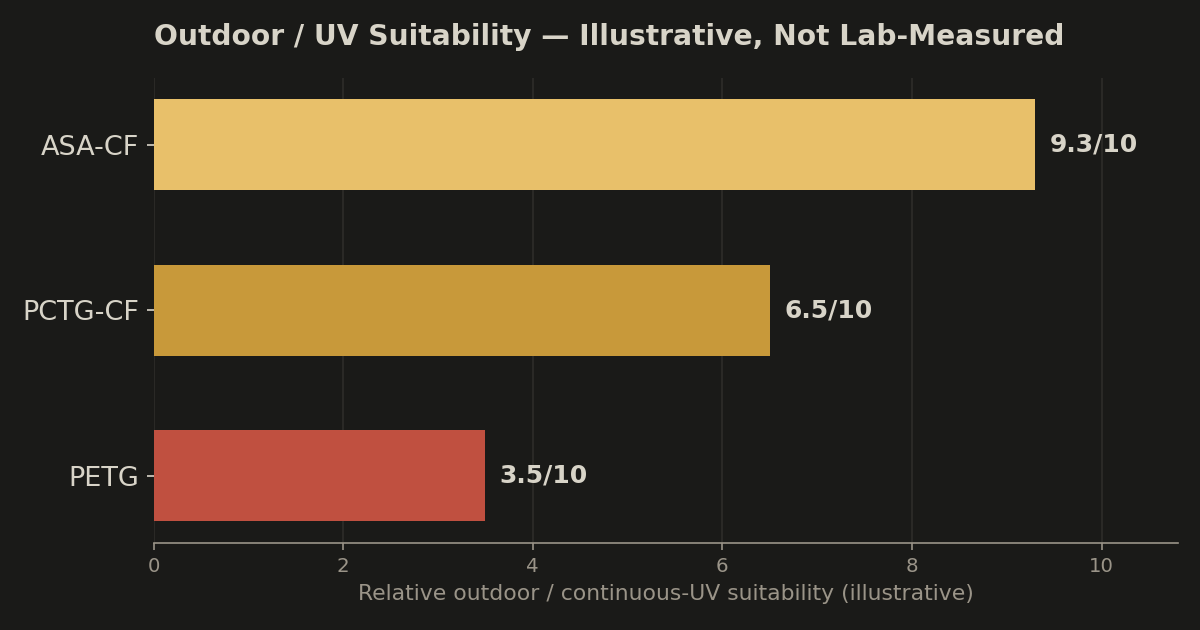
Here's the part that doesn't fit neatly into a spec sheet: PCTG resists yellowing better than PETG, but it will haze under prolonged, continuous direct UV exposure. It is not built for that the way ASA is — ASA's chemistry was engineered specifically for weathering resistance, and PCTG's wasn't.
What's honest to say about the timeline is that the real-world data is thinner than either material's marketing suggests. Accelerated lab testing with high-intensity UV lamps shows PCTG starting to show surface crazing at exposure levels equivalent to decades of normal outdoor sun — which sounds reassuring, but accelerated testing and real weather don't always track linearly, and that's a lab number, not a lived one. On the other side, some individual owners report PCTG parts sitting in direct sun for multiple years with no visible degradation. Neither of those is a controlled, published time-to-failure study. The honest answer is: PCTG-CF genuinely resists UV better than PETG, genuinely worse than ASA, and there isn't a clean, sourced number for exactly how many months of full sun it takes before it starts to show. If a part's job depends on surviving full sun for a specific period, don't guess with PCTG-CF — that's what ASA-CF's actual weathering-grade chemistry is for.
The Right Call vs. The Wrong Call
PCTG-CF is the right call
- Covered porch or under-eave brackets
- Planter housings and garden fixtures
- Humid-climate mounts that see rain, not baking sun
- Parts that need impact resistance plus some outdoor exposure
- Anything mixed indoor/outdoor use
PCTG-CF is not the honest choice
- Full, unbroken direct sun for months at a time
- Structural parts under continuous UV load
- Anything where color/surface finish must hold for years in the sun
- A part you can't inspect or replace easily if it hazes
How to Tell If Your Spot Counts as "Full Sun"
"Outdoor" isn't one condition, and treating it like one is how the wrong material gets picked. Before deciding between PCTG-CF and ASA-CF, check where the part actually sits:
Partial exposure — PCTG-CF territory
- Under a roof overhang, eave, or covered porch
- North-facing wall or shaded most of the day
- Morning sun only, shaded by early afternoon
- Dappled shade under trees for most of the day
Full sun — ASA-CF territory
- South- or west-facing with no overhang, 6+ hours of direct sun
- Open yard, roofline, or fence-top with nothing blocking it
- No shade at any point in the day, year-round
Where a spot sits between those two — say, direct sun for three or four hours a day, not six-plus — is exactly the situation where "how many months until PCTG-CF starts to haze" doesn't have a clean answer, which is why the previous section was upfront about that gap in the data rather than papering over it with a made-up number. If it's genuinely borderline, ASA-CF is the safer honest call; the cost difference is real but small compared to reprinting a part that hazed a year early.
If your part falls in that second list, say so when you order — ASA-CF is the material built for it, and DuffAM will steer you there instead of selling PCTG-CF a job it isn't built for.
Building Something for Outside?
Tell me where the part actually lives — covered porch or full sun — and I'll tell you straight whether PCTG-CF or ASA-CF is the honest call before you order.
Order Direct at DuffAM →