
Every filament manufacturer's spec sheet reads the same way: strong, durable, easy to print, great for functional parts. That's not useful when you're staring at a part that needs to survive a Charlotte summer on a porch railing, or snap-fit a thousand times without cracking, or just come off the printer without you babysitting a dryer for six hours first.
This is the honest version — eleven materials I actually keep on hand or have printed enough to trust, what each one is genuinely good at, and just as important, what it isn't. No material here wins every category, including the one I recommend most often.
Quick ReferenceAt a Glance
| Material | Best For | Watch Out For | |
|---|---|---|---|
| Everyday | PLA | Prototypes, decor, low-stress indoor parts | Softens in heat, brittle over time, poor UV |
| PETG | General-purpose tough parts, easier than ABS | Absorbs moisture faster than most realize | |
| PCTG | The better PETG replacement — tougher, similar cost | Not the UV specialist — ASA/ASA-CF beat it outdoors | |
| Flexible | TPU | Default flexible choice — easiest to print | Slower prints, not the most resilient flexible option |
| PEBA | Spring-back parts — cushioning, fatigue cycling, cold temps | Pricier and less common than TPU | |
| Engineering & Outdoor | ASA | Outdoor parts that need to survive UV/weather | Warps without an enclosure, fumes need ventilation |
| ASA-CF | Outdoor structural parts — brackets, enclosures | Abrasive on brass nozzles, more expensive | |
| PCTG-CF / PCTG-GF | Engineering parts needing more stiffness than plain PCTG | Still not the UV pick — ASA-CF wins outdoors | |
| PC | High-heat, high-strength parts | Warps aggressively, needs a hot enclosure | |
| PC-ABS | High-heat parts without pure PC's warping fight | Gives up some of PC's raw strength | |
| High Performance | Standard PA | General toughness, fatigue-resistant parts, snap-fits | Most hygroscopic material on this list — active drying required |
| PA6-CF / PA6-GF | High-stiffness structural parts, minimal flex | Still highly hygroscopic — same drying discipline as Standard PA | |
| PA12-CF | Precision parts needing dimensional stability | Lower moisture uptake than PA6 variants, still needs drying | |
| PA11 / PA12 (unfilled)* | Bio-based, low-moisture specialty grades — high impact, cable/tubing | *Not currently offered — ask if your part needs one | |
| Extreme | PPS-CF | Industrial heat/chemical exposure, near-metal stiffness | Needs industrial-grade hardware most desktop printers don't have |
PLA and PETG: Where Most People Should Start
PLA is still the right call for prototypes, decorative pieces, and anything that lives indoors and doesn't take real load. It prints easy and looks great, but it softens well below the inside of a hot car and it's genuinely poor in direct sun — plan for months, not years, on an outdoor PLA part.
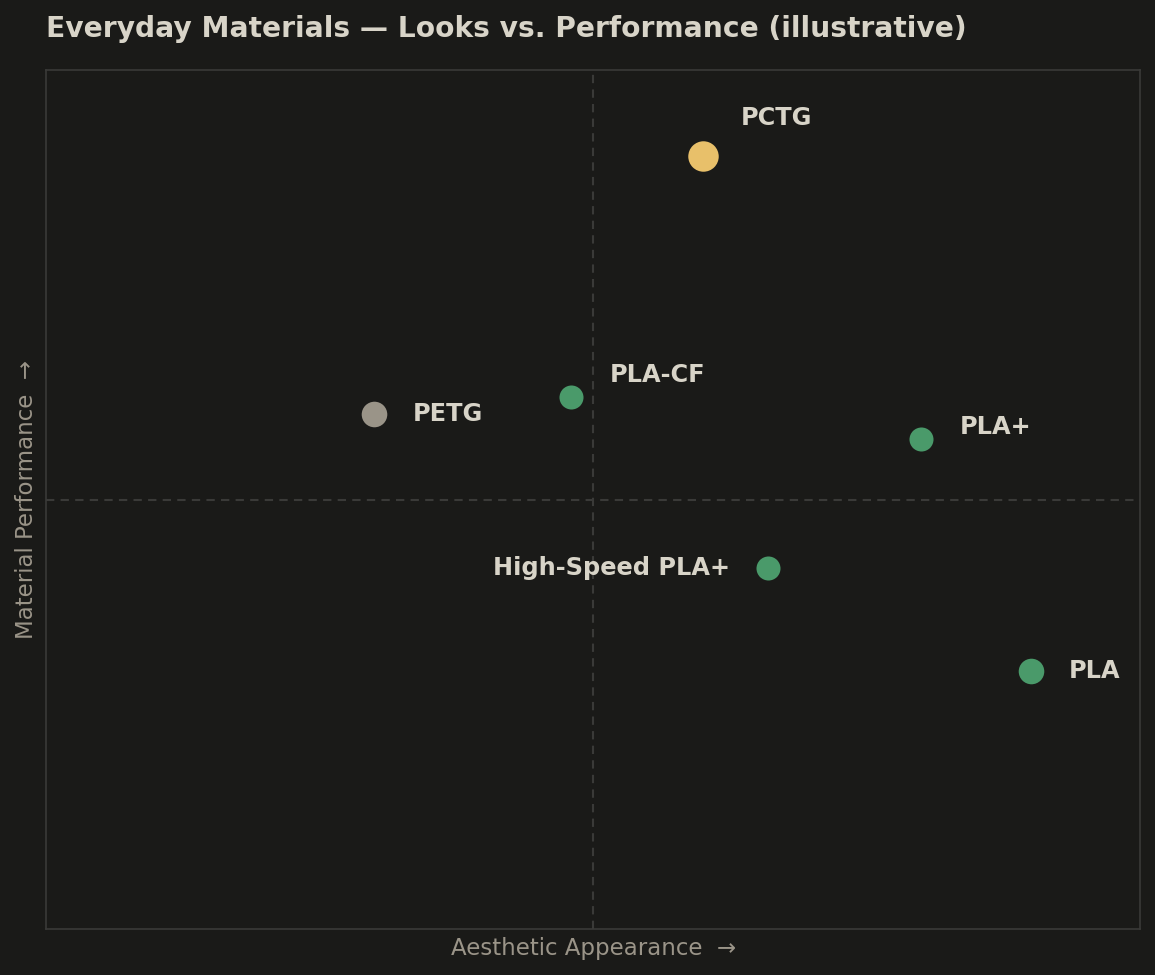
"PLA" isn't one material either — here's the breakdown, same honesty rule as everywhere else on this page. PETG and PCTG are shaded in below too, for a direct side-by-side rather than making you scroll back up:
| Material | Best For | Note |
|---|---|---|
| Standard PLA | Prototypes, decor, best out-of-the-box looks | The baseline — highest appearance, lowest durability of the family |
| PLA+ | Everyday parts wanting more toughness without leaving PLA | Less brittle, holds up to more handling, still easy to print |
| PLA-CF | Stiff, low-heat parts where rigidity matters more than impact strength | Carbon fiber cuts warping and adds stiffness, but more brittle and abrasive on nozzles |
| High-Speed PLA+ | Fast-turnaround decorative or light-functional parts on speed-tuned printers | Toughness of PLA+ without giving up print speed |
| Silk PLA* | Decorative parts wanting a glossy, silk-like sheen | *Not currently offered — ask if you want this look |
| PETG | General-purpose tough parts, easier than ABS | More moisture-sensitive than its reputation suggests |
| PCTG | The better PETG replacement — tougher, similar cost | Not the UV specialist — that's ASA/ASA-CF's job |
Shaded rows are PETG and PCTG — not PLA variants, just placed here for comparison. Details on both below.
PETG is the step up most people reach for, and for good reason — tougher than PLA, easier to print than ABS. The part people miss: PETG is more moisture-sensitive than its reputation suggests. It won't crackle and pop like Nylon, but a spool left open on a humid week will quietly print worse — more stringing, softer layer bonds — without an obvious warning sign.
If you're already looking at PETG, it's worth knowing what I'd actually recommend instead: PCTG. At a comparable cost, PCTG is tougher, absorbs less moisture (~0.15%, actually lower than PLA), and holds up better to real handling and impact — with almost none of PETG's stringing tendencies. For most everyday parts I'd steer you to PCTG over PETG by default — it's not a specialty upgrade, it does the same job better for close to the same money. If you're choosing on looks alone, standard PLA still wins — but that's the trade you're making.
TPU and PEBA
Flexible materials get judged on a different scale entirely — Shore hardness (how soft or firm) and elongation or rebound (how far it stretches, and how much energy it gives back), not tensile strength or UV resistance.
| Material | Shore Hardness | Elongation / Rebound | Best For |
|---|---|---|---|
| TPU | 85A–95A common range | High elongation, good abrasion/tear resistance | Default flexible choice — most versatile, easiest to print |
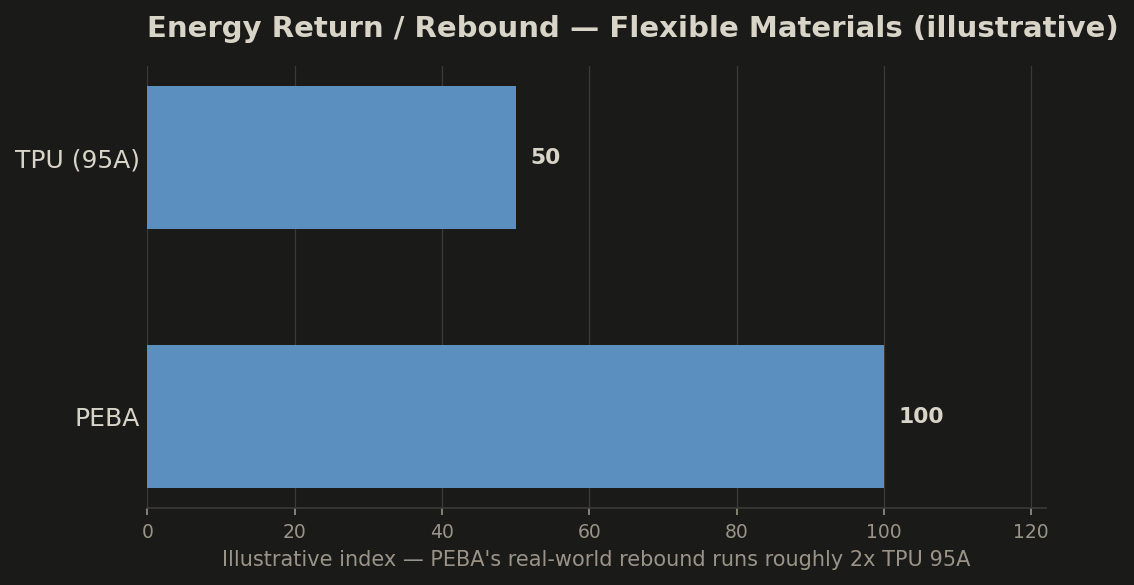
| PEBA | 80A–90A | Roughly 2x TPU's energy return/rebound | Cushioning, fatigue-cycling parts, cold-temperature flexibility |
TPU is the flexible material most people should start with — it prints more predictably than PEBA and covers the vast majority of flexible-part needs, from phone cases to gaskets to vibration dampeners.
PEBA is the specialist: when a part needs to compress and spring back thousands of times without going dead — think midsoles, suspension bushings, anything cyclical — its energy return is meaningfully better than TPU's, and it holds up better in cold. It's pricier and less common, which is exactly why most people default to TPU without knowing PEBA exists.
ASA, ASA-CF, PCTG-CF/GF, PC, and PC-ABS
This is the group people ask about most, because it's where "which material" actually changes whether the part survives its job.
| Material | Tensile Strength | Moisture Behavior | UV / Outdoor | Print Difficulty |
|---|---|---|---|---|
| ASA | ~35–45 MPa | Low-moderate | Excellent | Moderate — wants an enclosure |
| ASA-CF | Higher, stiffer than ASA | Low-moderate | Excellent — best of this group | Moderate-high, abrasive on brass nozzles |
| PCTG-CF | Higher, stiffer than plain PCTG | Low (~0.15%) | Good, not best | Moderate, abrasive on brass nozzles |
| PCTG-GF | Higher than plain PCTG, less brittle than CF | Low (~0.15%) | Good, not best | Moderate, easier on hardware than CF |
| PC | ~60–70 MPa | Low-moderate | Fair | Hard — high temps, warps without enclosure |
| PC-ABS | ~42 MPa | Low-moderate | Fair | Easier than pure PC, still wants heat |
If a part is going to sit outside — a mailbox bracket, a porch fixture, anything that sees direct sun for months — ASA or ASA-CF is the honest answer, not PCTG in any form. ASA's chemistry was built for UV stability the way PCTG's wasn't, and no amount of brand loyalty to a favorite material changes that. ASA-CF adds stiffness on top of that UV resistance for parts that also need to hold structural load outdoors, at the cost of being harder on nozzles and pricier.
For the deeper breakdown of exactly where PCTG-CF's moisture resistance earns its keep outdoors and where its UV story stops — see PCTG-CF Outside: What It Handles, and Where ASA Takes Over.
When a plain-PCTG part needs more stiffness than it can deliver — a bracket under real load, a fixture that can't flex — PCTG-CF and PCTG-GF step in. CF is stiffer and lighter but abrasive on brass nozzles and gives up some surface finish; GF gets most of the stiffness gain with an easier print and less hardware wear. Neither changes the UV story — for outdoor structural parts, ASA-CF still wins.
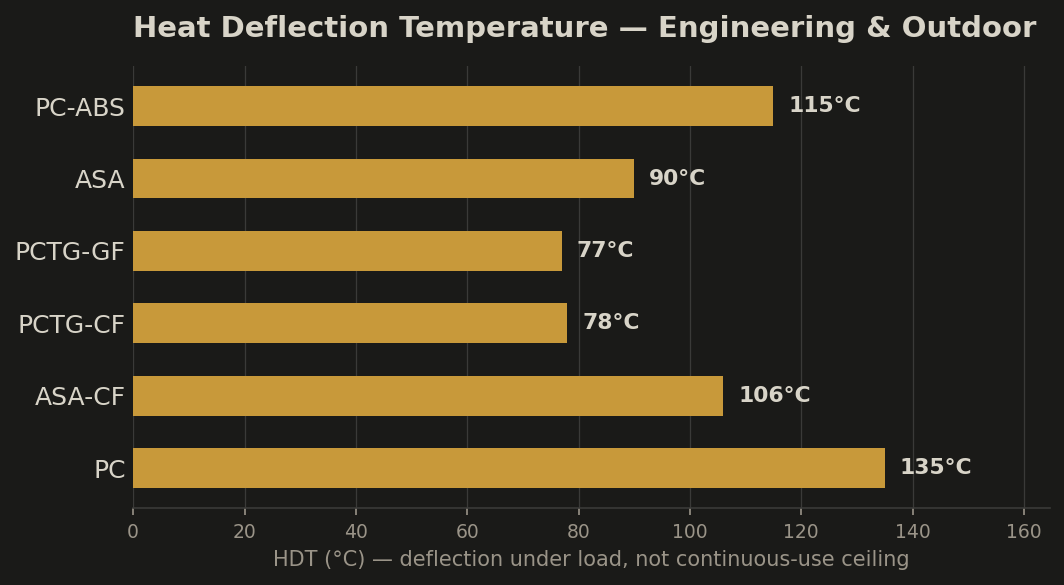
PC and PC-ABS earn their place when a part needs to survive real heat — near a heat source, inside a hot enclosure, somewhere PLA or PETG would visibly sag. Pure PC has the higher ceiling; PC-ABS trades a little of that strength for a print that fights you less.
PCTG isn't the strongest material on this list, and it isn't the most UV-resistant one — ASA and ASA-CF both beat it outdoors, and PC beats it on raw heat resistance. What plain PCTG wins is the everyday case: it prints almost as easily as PETG, tolerates humidity better than PLA (about 0.15% moisture absorption — lower than PLA itself), and holds up to real handling without the brittleness PLA eventually shows. For a functional part that isn't going outside and isn't going near real heat, it's the material I reach for by default — not because it's the best at any one number, but because it doesn't make you think hard about drying, warping, or bed adhesion to get a good result. Need more stiffness than plain PCTG offers? PCTG-CF and PCTG-GF carry the same easy-print, moisture-tolerant character up into engineering territory. When a part needs a true specialist — UV, heat, chemical exposure — I'll say so and point you at the material that's actually built for it.
Not All Nylon Is the Same Material
"Nylon" gets treated like one filament when it's really a family, and which variant you get changes the part's strength, stiffness, and how badly it'll punish you for leaving it unsealed. Here's the honest breakdown — including the variants I don't currently stock, so you know exactly what you're choosing between rather than a vague "Nylon options" line.
| Variant | Reinforcement | Moisture Behavior | Best For |
|---|---|---|---|
| Standard PA | Unfilled | Highly hygroscopic — most sensitive on this whole list | General toughness, fatigue-resistant parts, snap-fits |
| PA6-CF | Carbon fiber | Highly hygroscopic, slightly less than unfilled | High-stiffness structural parts, minimal flex |
| PA6-GF | Glass fiber | Highly hygroscopic, similar to PA6-CF | Stiffness with more impact tolerance than CF |
| PA12-CF | Carbon fiber | Lower moisture uptake than PA6 variants | Precision structural parts, dimensional stability |
| PA11* | Unfilled, bio-based | Best-in-class moisture resistance of the Nylon family | High-impact parts, cable/tubing, flex fatigue |
| PA12 (unfilled)* | Unfilled | Low — better than PA6, close to PA11 | Impact-tough parts with less rigidity than PA6 |
*I don't currently offer this material — if your part calls for it specifically, ask and I'll look into adding it.
Standard PA, PA6-CF, PA6-GF, and PA12-CF are all part of my regular material lineup. Across the whole family, moisture is the thing to respect — even the best-behaved variant here absorbs more than PLA or PCTG, and the unfilled/PA6 variants can go from printable to compromised in under six hours of open-air exposure in a humid room. If a part needs Nylon's toughness or fatigue resistance, budget for active drying as part of the job, not an afterthought.
PPS-CF: The Industrial Specialist
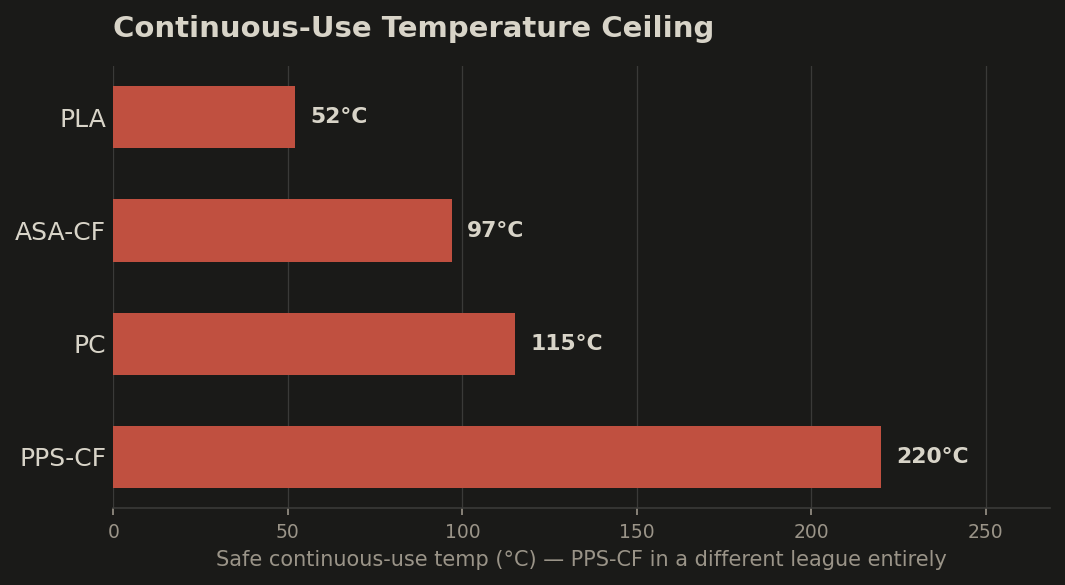
PPS-CF is in a different league from everything else on this list — continuous-use temperatures around 220°C, a heat deflection temperature near 260°C, UL94 V0 flame resistance, and strength that starts to approach metal in the right geometry. It's also the least forgiving material to print: it needs hardware most desktop printers simply don't have — an all-metal hotend rated well past what ASA or Nylon requires, and usually a heated chamber. This is the material for industrial, high-heat, or chemical-exposure applications, not a casual print.
Heat Deflection, Melting, and Real Continuous-Use Temps
Everything above should be enough to pick a material. This table is here for the part of you that wants the underlying numbers — heat deflection temperature (HDT, the point a material starts to bend under load), melting or softening range, and a realistic continuous-use ceiling for a part sitting under sustained heat, not a five-minute spike. Skip it if the categories above already answered your question.
| Material | HDT | Melting / Softening | Safe Continuous Use |
|---|---|---|---|
| PLA | 45–60°C / 113–140°F | 150–180°C / 302–356°F | ~50–55°C / 122–131°F |
| PETG | 65–75°C / 149–167°F | 230–260°C / 446–500°F | ~60–70°C / 140–158°F |
| PCTG | ~75°C / 167°F | 220–250°C / 428–482°F | ~65–70°C / 149–158°F |
| PCTG-CF | ~78°C / 172°F | 220–250°C / 428–482°F | ~70–75°C / 158–167°F |
| PCTG-GF | ~75–80°C / 167–176°F | 220–250°C / 428–482°F | ~70–75°C / 158–167°F |
| ASA | 85–96°C / 185–205°F | ~214°C / 417°F | ~80–85°C / 176–185°F |
| ASA-CF | 102–110°C / 216–230°F | ~210°C / 410°F | ~95–100°C / 203–212°F |
| PC | ~135°C / 275°F | ~250°C / 482°F | ~110–120°C / 230–248°F |
| PC-ABS | 110–120°C / 230–248°F | No sharp melt — softens above ~110°C / 230°F | ~95–105°C / 203–221°F |
| PPS-CF | up to 260°C / 500°F | ~285°C / 545°F (est.) | up to 220°C / 428°F |
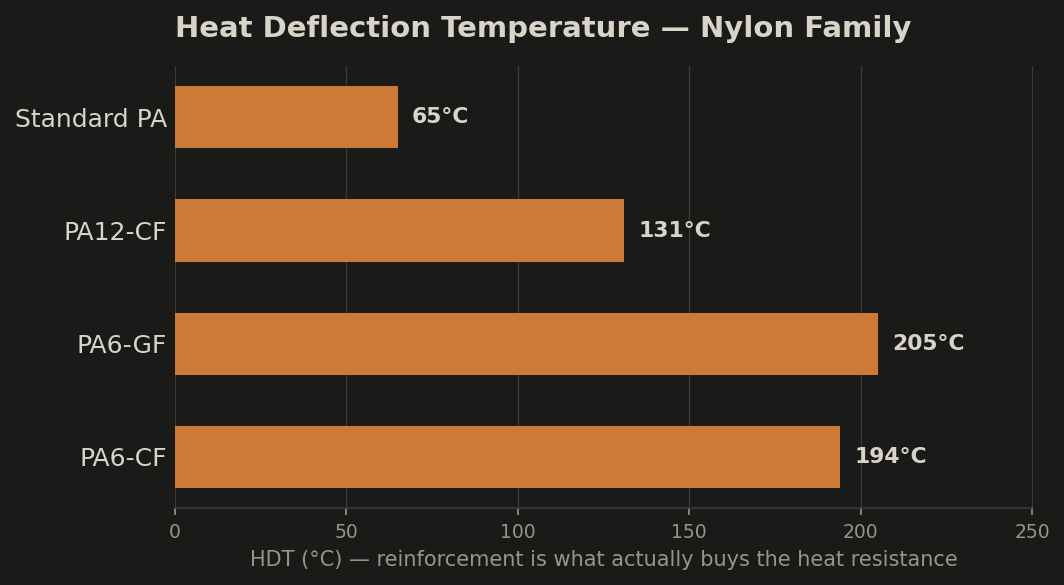
| Standard PA | ~65°C / 149°F (unreinforced) | 220–255°C / 428–491°F | ~80–100°C / 176–212°F |
| PA6-CF | 173–215°C / 343–419°F | ~219°C / 426°F | ~120–150°C / 248–302°F |
| PA6-GF | 200–210°C / 392–410°F | ~223°C / 433°F | ~120–150°C / 248–302°F |
| PA12-CF | ~131°C / 268°F (varies widely by brand) | 165–180°C / 329–356°F | ~90–110°C / 194–230°F |
| PA11* | data limited — varies by formulation | ~190°C / 374°F | ~80–100°C / 176–212°F (typical) |
| PA12 (unfilled)* | data limited — low under standard load | 178–180°C / 352–356°F | ~70–90°C / 158–194°F |
*Not currently offered — ask if your part needs it. Figures above are compiled from manufacturer datasheets and general engineering references; exact numbers vary by brand, fiber loading, and test method (ISO 75 / ASTM D648). HDT is a standardized deflection-under-load test — it is not the same as a safe continuous-use temperature, which is typically lower. Treat these as comparison points between materials, not a guarantee for your specific part and load case.
TPU and PEBA aren't in this table because HDT isn't a standard test for elastomers — they're rated by how much of their flexibility they keep across a temperature range, not by bending under load. Both process in a 210–245°C / 410–473°F melt range; PEBA holds its flexibility well below freezing better than TPU does, which is its real cold-weather advantage.
TakeawayThere's No Single Winner — That's the Point
If you take one thing from this: the right material question isn't "what's the best filament," it's "what does this specific part actually need to survive." Everyday functional parts that just need to work without a fight — that's where PCTG earns its spot as the default. Flexible with spring-back, PEBA over TPU. Outdoors and UV, ASA or ASA-CF. Real heat, PC or PC-ABS. High-fatigue mechanical load, the right Nylon variant. Industrial heat and chemical exposure, PPS-CF.
Not sure which of these your part actually needs? That's exactly the kind of question worth asking before you order, not after a part fails outside in July.
Not Sure Which Material Fits?
Tell me what the part needs to survive and I'll recommend the real material for the job — not just the one I like printing most.
Order Direct at DuffAM