You've run a retraction tower, bumped the distance to 2 mm, then 4 mm, and the hairs are still there. Now the nozzle is clicking and the walls have gaps. Retraction was never the whole problem. Stringing is plastic leaking from a hot nozzle while it crosses open air, and three separate things decide how much leaks. Retraction touches one of them.
| What you see | What it usually means |
|---|---|
| Crackle or pops, fuzzy surface, strings everywhere | Wet filament. Dry it before changing anything else. |
| Blob or drool at the start of every travel | Nozzle too hot. Drop 5°C at a time. |
| Strings only on long hops across gaps | Too much time in open air. Raise travel speed and acceleration. |
| Fine hairs, same spots every layer, dry filament | Retraction too short or too slow. |
| Gaps in walls right after a retract | Over-retraction. Back it off 0.2 mm at a time. |
| Worse on PETG than PLA with the same profile | Material. PETG stays runny at temperatures where PLA has already stiffened. |
Ooze is a budget with three line items
A nozzle that stops extruding is still full of molten plastic under pressure. How much of it escapes during a travel move depends on three things: the pressure left in the melt when the move starts, the viscosity of that melt (set by temperature, and by moisture if the filament is wet), and the time the nozzle spends over open air.
Retraction pulls filament back and drops the pressure. That is all it does. It can't thicken the melt, and it can't shorten the trip. If you spend your whole tuning session on the pressure term while the filament is wet and the nozzle is 15°C too hot, you will end up pulling the retraction so far that you starve the next extrusion.
The OrderFix them cheapest first
- 1Dry the spool.Water flashing to steam inside the nozzle makes bubbles, which push plastic out between moves. No retraction setting fixes that. If you hear crackling, stop here and dry it.
- 2Lower the nozzle temperature in 5°C steps.Print a small two-tower test at each step. Stop when stringing clears or layer bonding starts to suffer. Most of the gain is in the first 10°C.
- 3Shorten the trip.Set travel speed to 150–250 mm/s if the machine can hold it, and turn on the slicer's avoid-crossing-walls and wipe-on-retract options. Wiping moves the nozzle over the part so the leaking plastic lands on it instead of in the air.
- 4Tune retraction last.On a direct-drive extruder start near 0.8 mm at 35 mm/s. On a Bowden setup start near 4 mm at 45 mm/s. Change one number, in 0.2 mm steps on direct drive or 0.5 mm on Bowden, and keep only what the tower proves.
Work down the list. Stop at the first row that matches.
Faster travel has a ceiling
Raising travel speed is the step people skip, and it has a limit nobody tells you about. The nozzle can't instantly be at 300 mm/s, so a short hop never reaches top speed. At 3000 mm/s² acceleration, a 20 mm hop only drops from about 233 ms to 163 ms when you go from 100 to 300 mm/s, because it never reaches top speed. A 120 mm travel drops from about 1230 ms to 500 ms. If your strings are on short hops, acceleration is the lever. If they are on long crossings, speed is.
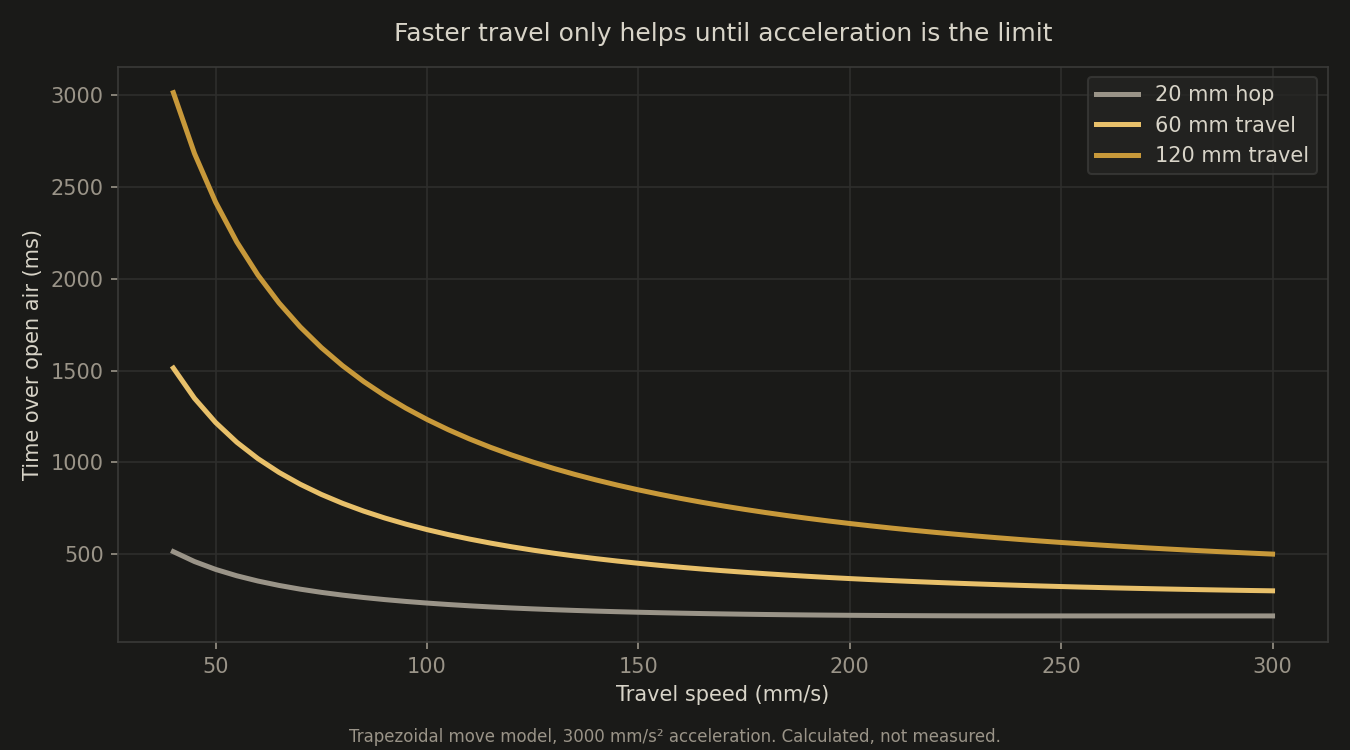
Calculated from a trapezoidal move at 3000 mm/s². Your printer's real acceleration will shift the curves.
When retraction becomes the new problem
Gaps in the first line after a travel, clicking from the extruder, or a clog that appears mid-print all point to retracting too far or too fast. A long retract pulls a molten plug up into the cooler zone, and it can jam there on the way back down. That's the same mechanism behind heat creep. If raising retraction made things worse, go back, dry the filament and cut the temperature instead.
PCTG is our recommendation for strings-prone jobs where PETG would normally be the first pick. Its modified CHDM structure and low moisture absorption (about 0.15%, lower than PLA) mean a dry spool stays dry longer on the printer, which takes the biggest stringing variable off the table. Start at the low end of the spool's printed temperature range and drop in 5°C steps from there.
- Filament dried and printed from a dry box or sealed spool
- Nozzle temperature lowered 5–10°C from the profile default
- Travel speed and acceleration raised to what the machine holds cleanly
- Avoid-crossing-walls and wipe-on-retract enabled
- Retraction changed one value at a time, verified on a tower
This is the process we use on the parts we ship: the settings are verified against a print, not copied from a profile. See how that works on the DuffAM process page.
Parts with no strings to clean up
Our parts are dried, temperature-tuned and verified before they ship, so you get clean travel surfaces without a week of retraction towers.
Order clean parts direct →