← Back to Field Notes
Replacing Assumptions and Hype With Intention in Additive Manufacturing
January 7, 2026 · 3 min read
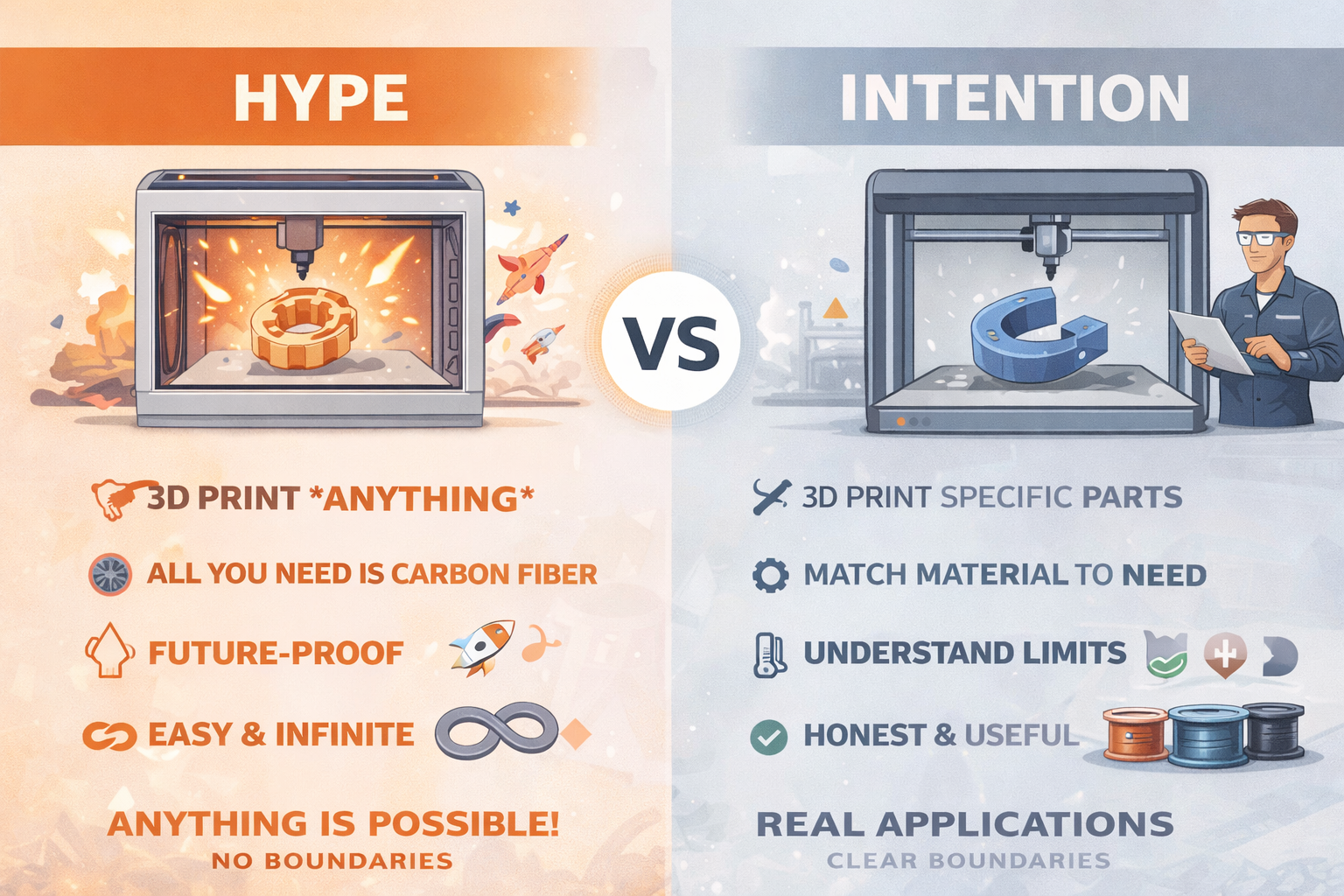
Additive manufacturing is often framed in extremes.
On one side, it’s dismissed as novelty—plastic trinkets, weak parts, and solutions in search of problems. On the other, it’s wrapped in hype: a promise that everything can be manufactured instantly, perfectly, and on demand if you just have the right printer, filament, or software.
Neither of these perspectives is particularly useful.
Additive manufacturing doesn’t need hype to be valuable. It needs intention.
The Problem With Assumptions
Many of the frustrations around 3D-printed parts come from assumptions—on both sides.
Some assume:
PLA is “junk plastic”PETG is only marginally betterPrinted parts are temporary or disposableAnything important must be made another way
Others assume:
Stronger materials solve all problemsCarbon fiber automatically means safer or betterMore expensive filaments equal better engineeringAdditive manufacturing can replace traditional manufacturing outright
Both sets of assumptions lead to disappointment.
The truth sits somewhere more practical—and far more useful.
Additive Manufacturing Is Not a Holy Grail
Additive manufacturing is not a shortcut to making anything possible at the click of a button. It doesn’t eliminate the need for judgment, boundaries, or responsibility.
What it does offer is something more grounded:
The ability to make specific parts for specific needsThe freedom to choose appropriate materials, not extreme onesThe opportunity to improve daily-life tools without overengineering them
When expectations are realistic, additive manufacturing becomes dependable instead of fragile—and empowering instead of disappointing.
Intention Over Capability
A useful printed part isn’t defined by what it could do under ideal conditions. It’s defined by what it is intended to do, consistently and safely.
That means being honest about:
How a part will be usedWhere it will be usedWhat loads or stresses it will actually experienceWhat it is not designed to handle
PLA and PETG thrive in this space. Not because they are magical materials, but because their behavior is predictable, repeatable, and well understood when used within clear boundaries.
Noise Exists When Boundaries Are Missing
Noise in the additive manufacturing space doesn’t come from material choice—it comes from missing context.
In Home and Personal Use
Noise looks like:
Parts sold without clear use limitsStrength claims with no definition“Universal” solutions that fit nothing wellExpectations that a printed part should behave like forged steel
This creates mistrust—not because additive manufacturing fails, but because expectations were never aligned with reality.
In More “Advanced” Applications
Noise also exists at higher tiers, just in a different form:
Materials chosen for marketing rather than needCarbon fiber used where geometry would have solved the issueComplexity added to justify capability instead of solving a problem
In these cases, hype replaces judgment, and additive manufacturing becomes intimidating rather than approachable.
Sometimes Overkill Isn’t About Strength
Not every material choice is driven by maximum load or stiffness.
A part like a carabiner-style clip may not need the additional strength of a carbon-fiber-reinforced polymer to meet its functional requirements. But using PETG-CF can still be the right choice.
Why?
Because:
It feels more solid in the handIt flexes less in useIt gives the user confidenceIt feels safe for everyday interaction
That confidence matters.
The part may never secure a load in a truck bed—but if it reliably clips keys, bags, or tools day after day, it has succeeded. And more importantly, it builds trust in the technology itself.
Trust Is Built Through Everyday Success
Additive manufacturing becomes meaningful when it quietly works in daily life.
When people:
Use printed parts without thinking about themRely on them without hesitationUnderstand their limits without fear
They stop seeing the technology as a novelty or a risk. They begin to see it as a tool.
That transition—from curiosity to trust—is what drives real adoption.
Making Advanced Manufacturing Approachable
Advanced manufacturing doesn’t need to be exclusive, extreme, or exaggerated.
It can be:
Honest about limitationsClear about intentThoughtful about material choiceFocused on real outcomes, not theoretical capability
You don’t need to believe that additive manufacturing can do everything. You only need to believe that it can do some things very well, when applied with care.
Real Intention for Real Parts
The goal isn’t to promise a future where everything is printable on demand. The goal is much simpler—and much more achievable:
To make parts that:
Solve real problemsFit their intended useInspire confidence instead of doubtImprove everyday life in small, reliable ways
When additive manufacturing is approached this way, it doesn’t need hype. It stands on results.
And results are what make the technology worth trusting.